Tom Seaver was the right-handed pitcher on Topps’ all-rookie team in 1967.
Seaver was drafted by the Dodgers in June 1965 but did not sign. He was then drafted by the Braves the following January, but the pick was voided by the commissioner on a technicality involving his college playing status. The Mets won a lottery (which also included the Phillies and Indians) and signed Seaver in April 1966.
After 1 season in the minors, “Tom Terrific” debuted with the Mets in April 1967, starting the 2nd game of the season, and going on to start 34 games and pitch 251 innings (leading the team in both categories). With 16 wins, he was the only Mets’ pitcher with double-digit wins, and was named the NL Rookie of the Year.
Seaver spearheaded the Mets' rise to respectability, after spending their first 7 seasons as the league's doormat. He was an all-star in 11 of his first 12 seasons (only missing in 1974). He also won the Cy Young award in ’69, ’73, and ’75. Tom was a 5-time 20-game winner, and led the NL in wins in 1969 and 1975. Seaver led the NL in strikeouts 5 times and ERA 3 times. All of the above stats were as Met.
During the 1977 season, he was traded to the Reds and continued winning through the 1981 season. After an off-year in 1982, he returned to the Mets for 1983 (another sub-par season), then had 2 good years for the White Sox (1984-85) before wrapping up his career in 1986 with the ChiSox and BoSox.
Seaver pitched in the post-season 3 times: ’69 and ’73 with the Mets, and 1979 with the Reds.
Monday, 26 November 2012
Thursday, 1 November 2012
Joe Sparma (#505)
Joe Sparma was the forgotten man for the Tigers in the 1968 post-season. The team's #4 starter, he was relegated to the bullpen for the post-season, since teams used a 3-man rotation in those days. He did pitch 1/3 of an inning in the Series.
Joe went to the same Massillon, Ohio high school as former Athletics' outfielder Mike Hershberger, although Joe was 3 years younger than Mike. Joe was also a quarterback at Ohio State in 1961 and 1962. He and teammate Paul Warfield led Ohio State to the Big 10 championship in '61.
Sparma was signed by the Tigers in 1963. After 1+ seasons in the minors he was called up in late-May 1964 and remained with the Tigers for the rest of the season, making 11 starts and 10 relief appearances.
Although Joe spent some time in the Tigers' bullpen in 1966 and 1969, he was primarily a starter during his years with Detroit. His best season came in 1967, when he collected 16 wins in 37 starts, while striking out 153 batters in 217 innings (all career highs for him. Sparma was pitching a no-hitter against the Pilots on 5/31/1969 when Don Mincher got a hit with one out in the 9th inning.
After feuding with manager Mayo Smith for more than a year, Joe was traded to Montreal in December 1969 for pitcher Jerry Robertson, who was 5-16 in his rookie season for the expansion Expos.
Sparma compiled an 0-4 record in 9 games (all by May 12th), and was promptly sent down to the minors for the rest of the 1970 season. He pitched for the Tigers' AAA team in 1971, before retiring.
Joe suffered a heart attack and died following bypass surgery on May 14, 1986 at age 44.
Joe went to the same Massillon, Ohio high school as former Athletics' outfielder Mike Hershberger, although Joe was 3 years younger than Mike. Joe was also a quarterback at Ohio State in 1961 and 1962. He and teammate Paul Warfield led Ohio State to the Big 10 championship in '61.
Sparma was signed by the Tigers in 1963. After 1+ seasons in the minors he was called up in late-May 1964 and remained with the Tigers for the rest of the season, making 11 starts and 10 relief appearances.
Although Joe spent some time in the Tigers' bullpen in 1966 and 1969, he was primarily a starter during his years with Detroit. His best season came in 1967, when he collected 16 wins in 37 starts, while striking out 153 batters in 217 innings (all career highs for him. Sparma was pitching a no-hitter against the Pilots on 5/31/1969 when Don Mincher got a hit with one out in the 9th inning.
After feuding with manager Mayo Smith for more than a year, Joe was traded to Montreal in December 1969 for pitcher Jerry Robertson, who was 5-16 in his rookie season for the expansion Expos.
Sparma compiled an 0-4 record in 9 games (all by May 12th), and was promptly sent down to the minors for the rest of the 1970 season. He pitched for the Tigers' AAA team in 1971, before retiring.
Joe suffered a heart attack and died following bypass surgery on May 14, 1986 at age 44.
Sunday, 28 October 2012
1967 World Series
I'd better get this posted, before the World Series ends.....
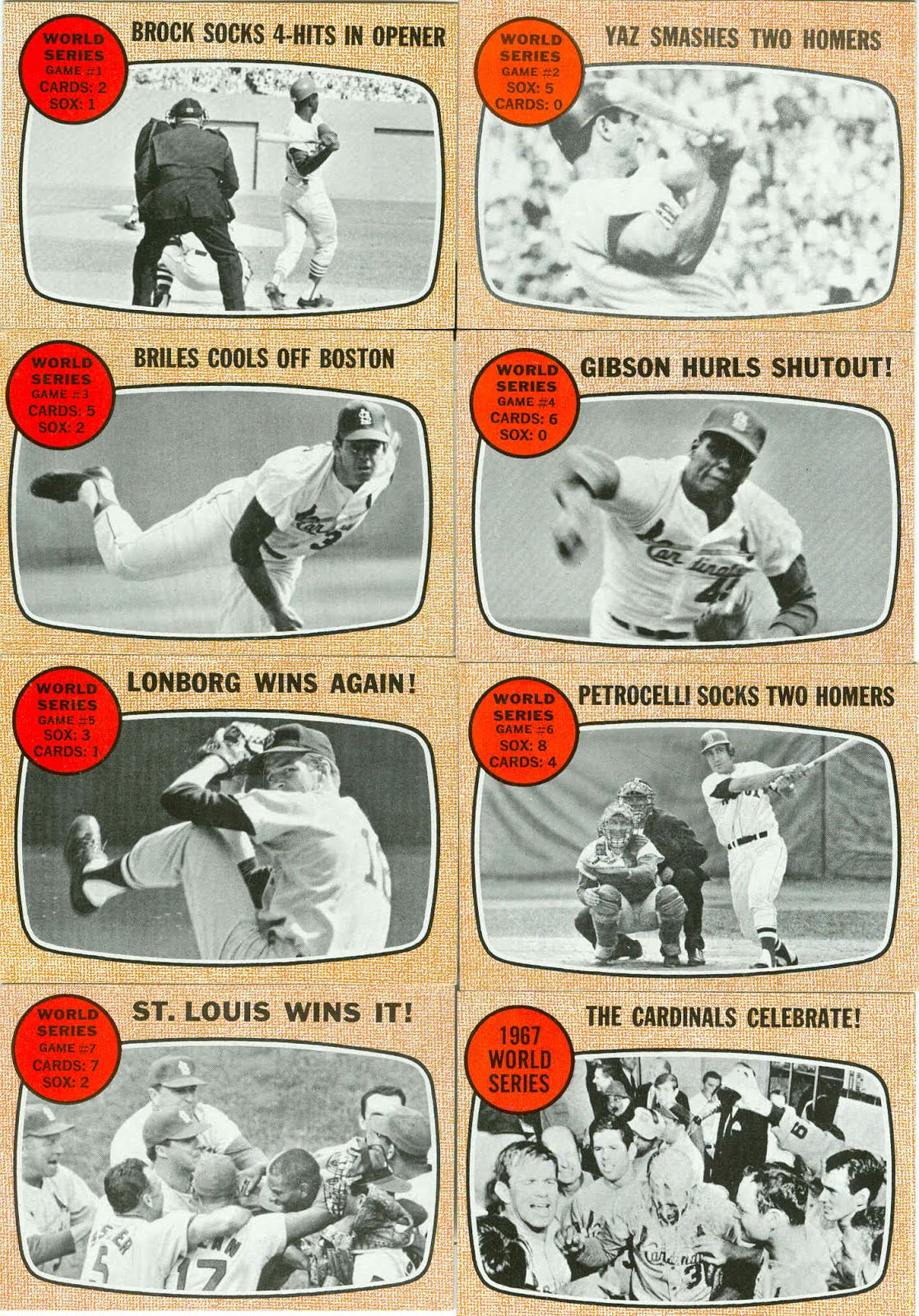
The 1967 Fall Classic featured the Cardinals and the Red Sox. The Cards were making their 2nd trip there in 4 years, while the Red Sox hadn't seen post-season action since 1946 (when coincidentally, their opponent was the Cardinals).
In 1967, Boston had just come off two 9th-place finishes, and entered the season not only with a new manager (Dick Williams), but it was Williams' 1st big-league managing assignment.
Leading the way for the rejuvenated Sox were triple-crown winner Carl Yastrzemski, pitcher Jim Lonborg, infielders George Scott and Rico Petrocelli, and outfielders Reggie Smith and (until his mid-August beaning) Tony Conigliaro.
The Cardinals were too much for the upstart Sox. This was a veteran club that had just won the Series in 1964, and had an all-star caliber player at just about every position.
In short...Gibson would just not lose. All St. Louis had to do was find one more win from among the rest of their rotation, which they did in game #3.
The 1967 Fall Classic featured the Cardinals and the Red Sox. The Cards were making their 2nd trip there in 4 years, while the Red Sox hadn't seen post-season action since 1946 (when coincidentally, their opponent was the Cardinals).
In 1967, Boston had just come off two 9th-place finishes, and entered the season not only with a new manager (Dick Williams), but it was Williams' 1st big-league managing assignment.
Leading the way for the rejuvenated Sox were triple-crown winner Carl Yastrzemski, pitcher Jim Lonborg, infielders George Scott and Rico Petrocelli, and outfielders Reggie Smith and (until his mid-August beaning) Tony Conigliaro.
The Cardinals were too much for the upstart Sox. This was a veteran club that had just won the Series in 1964, and had an all-star caliber player at just about every position.
In short...Gibson would just not lose. All St. Louis had to do was find one more win from among the rest of their rotation, which they did in game #3.
Monday, 22 October 2012
Phillies Rookies: Larry Colton / Dick Thoenen
This is the only Phillies Rookies card in the 1968 set (#348). (There was only one Phillies Rookies card in the '66, '67, and '68 sets. That number ballooned to 3 in the '69 set. Backlog of prospects? Nah.)
Each of these players had a major-league career lasting exactly one game. (Larry Colton pitched 2 innings on 5/6/1968, while Dick Thoenen pitched 1 inning on 9/16/1967.) This is the rookie card for both players, and the only card for Thoenen. Surprisingly, Colton re-appears on a 1969 Phillies Rookies card.
Larry Colton was signed by the Phillies in 1964, and was a starting pitcher in their farm system for 5 seasons (1965-69), starting at least 25 games each season except for 1968. That season, he spent part of the time riding the bench in Philadelphia, along with some time on the DL.
At the time, it was reported that he "hurt his shoulder reaching for the telephone on his bedside table". Years later, it was revealed that he was injured in a bar fight, and it cost him his shot in the majors.
After the '69 season, he was sent to the Cubs to complete the Johnny Callison for Dick Selma and Oscar Gamble trade. Colton pitched the 1970 season for the Cubs AAA team, then was out of baseball until pitching the 1975 season for an unaffiliated class A team.
At one time, Colton was married to the daughter of movie starHedley Hedy Lamarr.
Dick Thoenen was signed by the Phillies in 1963, and pitched for 7 seasons in their farm system. Although a starting pitcher for his first 3 seasons, he was converted to a reliever at the start of the 1966 season and worked out of the bullpen in double-A (1966), and triple-A (1966-69).
His cup of coffee was pitching the 4th inning in relief of starter Rick Wise. After giving up hits to the Dodgers' Bob Bailey and Luis Alcaraz, he retired Don Sutton, Nate Oliver, and Wes Parker in order.
I found this write-up about Dick Thoenen recently at the 11th & Washington blog. At the end of the blog post, there's a newspaper clipping listing the Phillies' September 1967 call-ups. Larry Bowa was among them, although he wouldn't get into a major-league game until April 1970.
Each of these players had a major-league career lasting exactly one game. (Larry Colton pitched 2 innings on 5/6/1968, while Dick Thoenen pitched 1 inning on 9/16/1967.) This is the rookie card for both players, and the only card for Thoenen. Surprisingly, Colton re-appears on a 1969 Phillies Rookies card.
Larry Colton was signed by the Phillies in 1964, and was a starting pitcher in their farm system for 5 seasons (1965-69), starting at least 25 games each season except for 1968. That season, he spent part of the time riding the bench in Philadelphia, along with some time on the DL.
At the time, it was reported that he "hurt his shoulder reaching for the telephone on his bedside table". Years later, it was revealed that he was injured in a bar fight, and it cost him his shot in the majors.
After the '69 season, he was sent to the Cubs to complete the Johnny Callison for Dick Selma and Oscar Gamble trade. Colton pitched the 1970 season for the Cubs AAA team, then was out of baseball until pitching the 1975 season for an unaffiliated class A team.
At one time, Colton was married to the daughter of movie star
Dick Thoenen was signed by the Phillies in 1963, and pitched for 7 seasons in their farm system. Although a starting pitcher for his first 3 seasons, he was converted to a reliever at the start of the 1966 season and worked out of the bullpen in double-A (1966), and triple-A (1966-69).
His cup of coffee was pitching the 4th inning in relief of starter Rick Wise. After giving up hits to the Dodgers' Bob Bailey and Luis Alcaraz, he retired Don Sutton, Nate Oliver, and Wes Parker in order.
I found this write-up about Dick Thoenen recently at the 11th & Washington blog. At the end of the blog post, there's a newspaper clipping listing the Phillies' September 1967 call-ups. Larry Bowa was among them, although he wouldn't get into a major-league game until April 1970.
Wednesday, 17 October 2012
Final Card: Recapping all 50
For the past few years, one of the recurring series on this blog has been a player's final card. The 1968 set includes the final card for 48 players and 2 managers, pictured below in order of years of service, from Eddie Mathews (17 years, and the only player to play for the Boston, Milwaukee, AND Atlanta Braves) to several players with 2-year careers (no 1-year wonders this time).
Some played several more seasons after their final card was issued (Pete Mikkelsen to 1972, Jim Bouton to 1970, plus a cameo in 1978), others went out on top (Mathews and Roger Maris played in the '68 World Series), or went out near the top (Elston Howard and Norm Siebern played in the '67 Series), while the vast majority just went.
Also check out the 1966 and 1967 final cards.
Some played several more seasons after their final card was issued (Pete Mikkelsen to 1972, Jim Bouton to 1970, plus a cameo in 1978), others went out on top (Mathews and Roger Maris played in the '68 World Series), or went out near the top (Elston Howard and Norm Siebern played in the '67 Series), while the vast majority just went.
Also check out the 1966 and 1967 final cards.
Saturday, 13 October 2012
Final Card: Bill Denehy
The last card in the 1968 "final cards" series...
This is the only solo card for pitcher Bill Denehy (#526). He also appeared on a Mets Rookies card in 1967 - a very pricey card, due to his cardmate Tom Seaver.
Denehy was signed by the Mets in 1965, and was a starting pitcher in their system for 2 seasons.
He made his major-league debut on 4/16/1967, but after going 1-7 in 15 games (8 starts), he was sent down in late June. After the 1967 season, Bill was traded to the Senators for MANAGER Gil Hodges.
Denehy only pitched 2 innings for the Nats in '68, but was 9-10 in 25 starts in the minors. He spent most of 1969-73 pitching in the minors for the Indians, Mets (again), Tigers, Yankees, Phillies, White Sox, and Red Sox.
In 1971, Bill spent all but the month of April pitching for the Tigers, appearing in 31 games (1 start).
This is the only solo card for pitcher Bill Denehy (#526). He also appeared on a Mets Rookies card in 1967 - a very pricey card, due to his cardmate Tom Seaver.
Denehy was signed by the Mets in 1965, and was a starting pitcher in their system for 2 seasons.
He made his major-league debut on 4/16/1967, but after going 1-7 in 15 games (8 starts), he was sent down in late June. After the 1967 season, Bill was traded to the Senators for MANAGER Gil Hodges.
Denehy only pitched 2 innings for the Nats in '68, but was 9-10 in 25 starts in the minors. He spent most of 1969-73 pitching in the minors for the Indians, Mets (again), Tigers, Yankees, Phillies, White Sox, and Red Sox.
In 1971, Bill spent all but the month of April pitching for the Tigers, appearing in 31 games (1 start).
Monday, 8 October 2012
Final Card: Fred Klages
Here is the final card for White Sox' pitcher Fred Klages (#229). He also appeared on a White Sox Rookie Stars card in the 1967 set.
Klages is from the sports hotbed of southwestern Pennsylvania, specifically Ambridge in Beaver County*, which is also the hometown of 1960s Detroit Lions middle linebacker Mike Lucci.
Fred was signed by the White Sox in 1962, and was a starting pitcher in their minor-league system for 8 seasons (1962-69), the last four in triple-A.
His brief major-league career started in September 1966, when he made 3 starts. In 1967, he made one start on June 14th, then another 10 appearances (mostly starts) from July 31st to the end of the season. His last major-league game came on September 11th - the one-year anniversary of his debut.
After 2 more seasons with the Sox' triple-A team, he played part of the 1969 season in the Mexican League.
* After clicking on the "Ambridge" link above, you can navigate to other sports stars from Beaver County, PA, including Joe Namath, Babe Parilli, Mike Ditka, Tony Dorsett, Po James, Tito and Terry Francona, Doc Medich, Hal Woodeshick, Joe Verbanic, Pete Maravich, and Norm Van Lier.
Klages is from the sports hotbed of southwestern Pennsylvania, specifically Ambridge in Beaver County*, which is also the hometown of 1960s Detroit Lions middle linebacker Mike Lucci.
Fred was signed by the White Sox in 1962, and was a starting pitcher in their minor-league system for 8 seasons (1962-69), the last four in triple-A.
His brief major-league career started in September 1966, when he made 3 starts. In 1967, he made one start on June 14th, then another 10 appearances (mostly starts) from July 31st to the end of the season. His last major-league game came on September 11th - the one-year anniversary of his debut.
After 2 more seasons with the Sox' triple-A team, he played part of the 1969 season in the Mexican League.
* After clicking on the "Ambridge" link above, you can navigate to other sports stars from Beaver County, PA, including Joe Namath, Babe Parilli, Mike Ditka, Tony Dorsett, Po James, Tito and Terry Francona, Doc Medich, Hal Woodeshick, Joe Verbanic, Pete Maravich, and Norm Van Lier.
Subscribe to:
Posts (Atom)