Showing posts with label ...high numbers (6th series not sold in my town in 1968). Show all posts

Sunday, 14 July 2013

Frank Robinson (#500)

Continuing the mini-series on "cards ending with "00", here is #500 Frank Robinson.

I have to take issue with Topps' selection of Robinson. Wasn't #500 the ultimate "hero number" back in the day? ( In 1969, Mickey Mantle's final card was #500.)

Prior to the 1966 season, Robinson came over to the Orioles in a big trade with Cincinnati. In his first season with the O's, he won the Triple Crown, the AL MVP, and the World Series MVP.

Still, that was 2 years ago, and since then Carl Yastrzemski won the 1967 Triple Crown and played in the World Series, and several members of the world champion Cardinals (Bob Gibson, Orlando Cepeda) had monster years. Was Topps making amends for "only" giving Robby #100 in the 1967 set?


Robinson was signed by the Reds in 1953, and after 3 seasons in the minors, he spent 10 full seasons as a regular with Cincinnati.  He was the Rookie of the Year in 1956, and the NL MVP in 1961.

He played in 4 World Series during his six seasons with Baltimore. In 1972 he began bouncing around to several teams as his playing career wound down: Dodgers ('72), Angels ('73, '74), and Indians ('74-'76).

He also managed the Indians (1975-77), Giants (1981-84), Orioles (1988-91), and the Expos/Nationals (2002-06).  In 16 seasons as manager, his teams finished as high as 2nd place twice.


Thursday, 1 November 2012

Joe Sparma (#505)

Joe Sparma was the forgotten man for the Tigers in the 1968 post-season. The team's #4 starter, he was relegated to the bullpen for the post-season, since teams used a 3-man rotation in those days. He did pitch 1/3 of an inning in the Series.

Joe went to the same Massillon, Ohio high school as former Athletics' outfielder Mike Hershberger, although Joe was 3 years younger than Mike. Joe was also a quarterback at Ohio State in 1961 and 1962. He and teammate Paul Warfield led Ohio State to the Big 10 championship in '61.

Sparma was signed by the Tigers in 1963. After 1+ seasons in the minors he was called up in late-May 1964 and remained with the Tigers for the rest of the season, making 11 starts and 10 relief appearances.


Although Joe spent some time in the Tigers' bullpen in 1966 and 1969, he was primarily a starter during his years with Detroit. His best season came in 1967, when he collected 16 wins in 37 starts, while striking out 153 batters in 217 innings (all career highs for him. Sparma was pitching a no-hitter against the Pilots on 5/31/1969 when Don Mincher got a hit with one out in the 9th inning.

After feuding with manager Mayo Smith for more than a year, Joe was traded to Montreal in December 1969 for pitcher Jerry Robertson, who was 5-16 in his rookie season for the expansion Expos.

Sparma compiled an 0-4 record in 9 games (all by May 12th), and was promptly sent down to the minors for the rest of the 1970 season. He pitched for the Tigers' AAA team in 1971, before retiring.

Joe suffered a heart attack and died following bypass surgery on May 14, 1986 at age 44.

Saturday, 13 October 2012

Final Card: Bill Denehy

The last card in the 1968 "final cards" series...

This is the only solo card for pitcher Bill Denehy (#526). He also appeared on a Mets Rookies card in 1967 - a very pricey card, due to his cardmate Tom Seaver.

Denehy was signed by the Mets in 1965, and was a starting pitcher in their system for 2 seasons.

He made his major-league debut on 4/16/1967, but after going 1-7 in 15 games (8 starts), he was sent down in late June. After the 1967 season, Bill was traded to the Senators for MANAGER Gil Hodges.


Denehy only pitched 2 innings for the Nats in '68, but was 9-10 in 25 starts in the minors. He spent most of 1969-73 pitching in the minors for the Indians, Mets (again), Tigers, Yankees, Phillies, White Sox, and Red Sox.

 In 1971, Bill spent all but the month of April pitching for the Tigers, appearing in 31 games (1 start).

Sunday, 30 September 2012

Final Card: Bill Kelso

This is the final card for Bill Kelso, and his only solo card (#511). He previously appeared on Angels Rookie Stars cards in the 1965 and 1967 sets. Kelso appeared in the majors in 4 seasons, but primarily 1967 and 1968.


Bill played in the Dodgers' farm system from 1959 to 1963. For his first 4 seasons he was a catcher, only pitching 3 games in 1962 before converting to full-time pitcher in 1963. After the season, he was selected by the Los Angeles Angels in the Rule 5 draft.

Kelso pitched the next 3 seasons in the Angels' system, while also pitching 10 games in the majors during 1964 and 5 games in 1966. Bill was primarily a reliever, except for his minor-league 1964 season.

1967 was the only season Kelso was not in the minors. He made 1 start and 68 relief appearances, and had a 2.97 ERA during his rookie season, and was the #2 reliever behind veteran closer Minnie Rojas.

After the season, he was traded to the Reds for starting pitcher Sammy Ellis, a 22-game winner in 1965. Neither Kelso or Ellis ever approached the success they had prior to the trade. Kelso made 29 relief appearances for the Reds through mid-July, then was sent down to AAA where he appeared in 20 games before his September recall. He finished out the season with 6 more relief appearances in the final weeks.

Bill pitched in the minors for 4 more seasons (mostly as a starter), with the Royals, Twins, Athletics, Expos, and Cubs.

After his playing career, Kelso scouted for the Angels, Phillies, and Astros.  Some of his signees were Bob Dernier, Lance Berkman, and Roy Oswalt.

He passed away on 5/11/2009 at age 69.

Tuesday, 4 September 2012

Final Card: Clarence Jones

This is the first and last card for Clarence Jones (#506). For the second consecutive post, we are saying goodbye to a short-time Cubs' first baseman.

Jones was signed by the Phillies in June 1959. After finishing that season in the Phillies' organization, he was out of baseball in 1960. Clarence returned in 1961, and spent the next 5 seasons in the Dodgers' farm system.


After the 1965 season, he was drafted by the Cubs, and finally made it up to triple-A during the 1966 season.

Jones made his major-league debut in April 1967 with the Cubs. He played in 53 games that year, mostly as a pinch-hitter, but also 2 dozen games in right field and a dozen as Banks' backup at 1st base. He also spent mid-May to mid-July back in the minors.

The following season, he was back in triple-A for most of the season, only playing 5 games with the Cubs in September. After the '68 season he was dealt to the Reds, but spent the 1969 season at triple-A Indianapolis.

Jones then played in Japan from 1970 through 1977.

Saturday, 18 August 2012

Final Card (the bonus tracks): Pete Mikkelsen

So, I was browsing through my 1968 binder, pulling all the final cards I previously posted, for a "Final Cards Recap" post (like I did with the 1967 set). After 2 or 3 pages, I was thinking "hey, what about this guy...and that guy... and that guy?" 

I ended up with a list of 65 other players whose final card may have also been in the '68 set. After checking the Zistle database, I whittled the list down to 8 players (of which 3 are Cubs) that I missed the first time around. So here they are, the "bonus tracks".


Pete Mikkelsen's final card (#516) was in the 1968 set, despite the fact that he pitched over 150 games from 1969-72 as a member of the Dodgers' bullpen. Thanks, Topps!


Pete was signed by the Yankees in 1958, and played in the minors for 6 seasons, primarily as a reliever, but making many starts during the 1959-61 seasons. In his 9-year major-league career, Mikkelsen played 364 games, starting only 3 (in 1965).

His debut came in April 1964, and he appeared in 50 games, saving 12 as the Yankees' closer in his rookie season. After another season in the Bronx, Pete was traded to the Pirates for pitcher Bob Friend, who had been a key member of Pittsburgh's starting rotation for the past 15 seasons. Mikkelsen lasted just 1 1/2 seasons with the Bucs, and was claimed off waivers by the Cubs on August 4th, 1967.

The following April, he was traded to the Cardinals for pitcher Jack Lamabe. Ok! Moving up from the Cubs to the World Champion Cardinals! Not so fast... Pete pitched 5 games for St. Louis in June, but spent the rest of the season in triple-A.

After the season, he was traded to the Dodgers for a minor-league pitcher. Pete spent his final 4 seasons working out of the Dodgers pen, and it was a productive 4 years. The righthanded Mikkelsen was the team's #2 reliever during his 4-year stay, just behind ace southpaw Jim Brewer.

Why did Topps leave him behind? 1969 is understandable (after spending most of '68 in the minors), but what about the other years? The GarveyCeyRussellLopes blog has done what Topps was unwilling to do.

Monday, 12 March 2012

Lee May (#487)

For 6 straight seasons in the 1960s, the Cincinnati Reds had at least one of the 10 Topps All-Star Rookies:

1963 - Pete Rose 2B, Tommy Harper OF
1964 - Bill McCool P
1965 - Tony Perez 1B
1966 - Tommy Helms 3B
1967 - Lee May 1B
1968 - Johnny Bench C

(What, no shortstop?)

Lee May was signed by the Reds in 1961, and played for 6 seasons in their farm system, mostly at first base, with a few games as an outfielder in 1964 and 1965. Those 2 seasons were big for May, as he batted over .300 and collected over 100 RBI each year. He also hit 25 and 34 homers, respectively.

Lee got a big-league cup of coffee in 1965 and another 25 games in 1966, before making the Reds for good at the start of 1967.


I always thought the arrival of Lee May in 1967 set the Reds' defense in shuffle mode: Tony Perez from 1B to 3B, Tommy Helms to 2B, and Pete Rose to the outfield. In fact, Helms and Rose had moved at the start of the season, before May cracked the starting lineup, (with Deron Johnson coming in from left field to play 3B). In early May, Perez moved from 1st to 3rd, with Johnson and May alternating chunks of games as the starting 1st baseman. (Lee also spent about a month in left field, with Rose returning to 2B and Helms to shortstop during Chico Cardenas' trip to the DL.) By the time the season was over, May had started 68 games at 1B and 47 in the outfield.

Things settled down defensively in 1968. In the off-season, Johnson was traded to Atlanta which opened up a full-time 1st base job for May. Lee began a string of 11 very productive seasons. He was with the Reds through 1971, then 3 seasons with the Astros (sent there in the Joe Morgan trade), before settling in Baltimore in 1975.

May was the Orioles' 1st baseman in his 1st season there, then eased into the DH role in '76 and '77 before becoming the full-time DH in '78 and '79. In his last 3 seasons, May was relegated to a part-time role, the final 2 with Kansas City.

Lee retired after the 1982 season. His brother Carlos was the White Sox' regular left fielder during the early 1970s.

Sunday, 12 February 2012

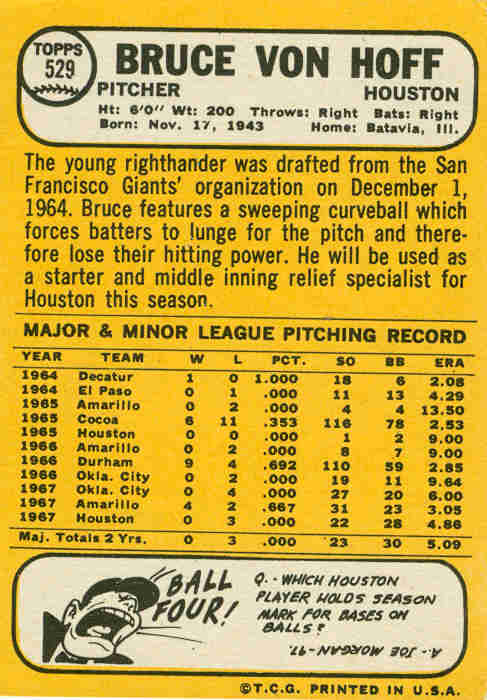
Final Card: Bruce Von Hoff

This is the only Topps baseball card for Bruce Von Hoff (#530). Like Ron Campbell in 1967, and Dave Watkins in 1970, his major-league career was over before his only card was issued.


Bruce was signed by the Giants in 1964, and pitched in the minors for 7 seasons (1964-70), mostly at the double-A and A levels. He was a starting pitcher in all but his first season. After one season in the Giants' system, Von Hoff pitched for various Astros' clubs for 4 seasons, before moving on to the Reds (1969) and Cardinals (1970).

His only big-league experience came in 1965 (3 relief appearances, 3 innings) and 1967 (10 starts, 50 innings total).

I'm surprised he even has a card in this set, since a) he wasn't one of the Astros' top 12 pitchers in 1967 in terms of games played, and b) this is card #529 (in the last series), so there was plenty of time for Topps to pull this card in favor of someone else more deserving (like a Giants Rookie Stars card!)

Saturday, 14 May 2011

Dick Tracewski (#488)

Over the next few posts, I am going to be completing my series on players who retired in the late 1960s (specifically, those players who retired in 1968 or 1969, or whose last card was in 1968).

This post was going to be about 8-year veteran Dick Radatz (who retired in 1969). When I went to my 1968 binder (which is arranged by teams) to retrieve his card, I couldn't find it. Indians? No. Red Sox? No. What the? After consulting my Book of All Topps Knowledge I learned that the veteran Radatz did not have a card in 1968. He was released by the Cubs during spring training in 1968, and spent the entire season with the Tigers' triple-A team, before returning to the majors for one more season in 1969.

I will have to update my list of players without a 1968 card. Meanwhile, on to fellow 8-year-veteran-retiring-in-1969 Dick Tracewski.


Tracewski was signed by the Brooklyn Dodgers in 1953. After 5 seasons in the minors, Dick spent 1958 and 1959 in military service. He returned to another 3 seasons in the minors, and made the Dodgers at the start of the 1963 season.

Tracewski had significant playing time during his first 2 seasons with the Dodgers, backing up Maury Wills at SS in 1963, and sharing 2B with Nate Oliver in 1964. In 1965 he received less playing time than before, primarily as Junior Gilliam's backup at 3rd base. Dick saw action in the 1963 and 1965 World Series with the Dodgers.

After the 1965 season, Dick was traded to the Tigers for relief pitcher Phil Regan. With the Tigers, Tracewski was relegated to 3rd-string middle infielder, especially after the arrival of rookie Tom Matchick in 1968. Still, Tracewski played briefly in his 3rd World Series in 1968. He retired after the 1969 season.

Wednesday, 25 August 2010

Back on Topps' Radar: Jerry Stephenson

Jerry Stephenson (#519) appeared on baseball cards in 1965 and 1966, but not in 1967. He returns to the Topps card set in 1968.

Stephenson was signed by the Red Sox in 1961, and pitched 3 years (1962-64) as a starter in the minors before making the Red Sox team in 1965. Jerry remained on the team for the entire season, starting and relieving a total of 15 games.

In 1966, he started 11 of his 15 games (as one of 6 pitchers used in the back of the rotation behind Jim Lonborg, Jose Santiago, and Earl Wilson). Jerry also spent some time with triple-A Toronto.


Stephenson spent most of 1967 with Toronto, but also appeared in 8 games for Boston during the regular season, as well as pitching in the World Series. 1968 was not only his last year with Boston, but would also be his last full season in the majors. He was used mainly in long relief (23 games, 68 innings).

Stephenson was released by the Red Sox on April 17, 1969, and signed by the expansion Seattle Pilots on the same day. Appearing in only 2 games for the Pilots, he spent most of the season with their AAA club in Vancouver.

Jerry was traded to the Dodgers prior to the 1970 season, but only played 3 games for Los Angeles. He was a starter for the Dodgers' AAA teams (Spokane, then Albuquerque) from 1970 to 1972, before becoming their closer in 1973, his final season in baseball.

Saturday, 13 March 2010

Final Card: Chuck Hiller

Chuck Hiller (#461) was signed by the Indians in 1957, and played 2 seasons in their low minors before the Giants selected him in the 1958 minor-league draft. After 2 more seasons in the Giants' organization, Hiller made his major-league debut with the Giants on April 11, 1961.

After starting 16 of the first 17 games at 2nd base, Chuck slowly lost his grip on the starting job to Joey Amalfitano, and by season's end, Chuck had 63 starts (to Amalfitano's 88).

Amalfitano was lost in the post-season expansion draft, so Hiller was now in full control at 2nd base, starting 158 games in 1962, and 101 games in 1963 (alternating with the re-acquired Amalfitano).


In 1964, rookie Hal Lanier got the bulk of playing time at 2nd, relegating Hiller to a backup role. Eventually, Chuck was sold to the Mets on May 11, 1965. In New York, he was in a 3-way timeshare at 2nd base with Bobby Klaus and Ron Hunt.

Hunt took over the 2nd base job in 1966, pushing Hiller to his now-familiar role as utility/pinch-hitter. In July 1967, the location changed (Phillies) but not the job.

After the 1967 season, the Pirates selected him from the Phillies in the rule 5 draft. After 11 games with the Pirates in 1968 (the last on June 2nd), Hiller's 8-year major-league career was over.

He spent the remainder of 1968 with the Pirates' triple-A team in Columbus, Ohio before retiring.

Monday, 8 March 2010

Final Card: Jimmie Schaffer

Tonight, my blogs feature another triple-shot of Cincinnati Reds (for no particular reason). However, these 3 cards don't match as well as Zanni-Coker-Nottebart did a few days ago.

Here is the final baseball card for journeyman backup catcher Jimmie Schaffer (#463). After having a card for each year from 1962 to 1965, Schaffer fell off Topps' radar in 1966 and 1967. Now he's back for one more card, though I don't see how he swung it, based on 2 at-bats in 1967!

Jimmie was signed by the Cardinals in 1955, and spent six full seasons and part of 1961 in the minors before making his major-league debut on May 20, 1961. That season, he started 45 games behind the plate - the most by any of the 6 catchers used by the Cardinals that season.


In 1962, Schaffer settled back into the backup role (behind Gene Oliver and Carl Sawataski) that would follow him for the rest of his career. After the season he was traded to the Cubs (along with pitchers Larry Jackson and Lindy McDaniel) for pitcher Don Cardwell, outfielder George Altman, and catcher Moe Thacker.

Jimmie was the Cubs 2nd-string catcher (behind Dick Bertell) for the 1963 and 1964 seasons. He was traded to the White Sox in December 1964, and split the 1965 season between the White Sox and the Mets. That was pretty much the end of Schaffer's major-league career.

Prior to the 1966 season, Schaffer was one of three players the Mets traded to the Phillies for first baseman Dick Stuart. Jimmie spent the 1966 and 1967 seasons with the Phillies' triple-A team in San Diego, getting only a few at-bats in September call-ups each season.

Schaffer only played 4 games for the Reds in 1968, his final game coming on July 11th, He spent most of 1968, and all of 1969 and 1970 with the triple-A teams of the Reds, Dodgers, and Orioles.

Wednesday, 24 February 2010

Back on Topps' Radar: Diego Segui

I haven't posted any of these recently. Diego Segui (#517) had baseball cards in every season from 1963 to 1975 except for 1967.

Segui was signed by the Cincinnati Reds prior to the 1958 season, but released in early April. He caught on with the Tucson Cowboys, an independent team in the class-C Arizona-Mexico league. At the end of the 1958 season, he was acquired by the Kansas City Athletics.

Diego spent the next 3 seasons in the Athletics' farm system before making his major-league debut in April 1962. For his first 2 seasons, he was a starter and reliever. In 1964, he was primarily a starter. His 35 starts led the Athletics staff. Unfortunately, his 17 losses was the most in the American League. In 1965, he returned to a combined starting/relieving role.

(at least Topps used green to airbrush his cap!)

Two days after the 1966 opener, Segui was sold to the Washington Senators. By the end of July (after 21 appearances), the Nats traded him back to Kansas City for pitcher Jim Duckworth. However, he was relegated to triple-A for the rest of the season (hence, no 1967 baseball card!)

In 1967 Diego started 7 games in triple-A, and appeared in 36 games for Kansas City (only 3 starts). Segui was strictly a reliever in 1968, making 52 appearances as the #2 man in the bullpen behind "closer" Jack Aker.

Segui was selected by the Seattle Pilots in the 1969 expansion draft. (Later in the draft, the Pilots also plucked Aker from the A's bullpen.) Segui led the Pilots in saves (12), games (66), winning percentage (.667), was second in wins (12) and 1st among relievers in innings (142). His fine performance earned him a ticket out of Expansionville as he was traded back to the Athletics in December 1969 (along with shortstop Ray Oyler) for infielder Ted Kubiak and pitcher (and frequent Topps' "Rookie Star") George Lauzerique.

After winning 10 games for the Athletics in each of 1970 and 1971, Segui was shipped to the Cardinals midway through the 1972 season. After 1 1/2 seasons in St. Louis, Diego moved on to Boston in a 6-player deal.

He spent the 1974 and 1975 seasons in the Red Sox' bullpen, and was released in spring training in 1976. The Padres signed him, but kept him in triple-A all season.

Segui wrapped up his 15-year career in 1977 with the Mariners.

His son David played for the Orioles and other teams from 1990-2004.

Friday, 5 February 2010

Final Card: John Wyatt

John Wyatt (#481) was signed by the Cardinals way back in 1954, and played one season for their class-D team in Hannibal, MO before being released the following spring.

John played all of 1955 and part of 1956 with the Indianapolis Clowns of the Negro American League. During 1956, he also pitched for minor-league teams in the Braves' and Athletics' organizations.

1957 and 1958 are unaccounted for in his records (possibly back in the Negro Leagues?), but after spending the 1959-1961 seasons in Kansas City's farm system, he made his major-league debut in September 1961.

In 1962, John began a string of 4 seasons as the Athletics' closer. He led the league with 81 games pitched in 1964.


(Wow, there's a lot of wasted space on the back of this card!)

In June 1966, after 19 relief appearances he was traded to the Red Sox in a 6-player deal. John made 42 more appearances for the Red Sox that season, then in 1967 took over Boston's closer role from the departed Don McMahon. With Boston, he won game 6 in the 1967 World Series.

John's last 2 seasons were lived out of a suitcase. In May 1968 he was sold to the Yankees. A month later the Yanks sold him to the Tigers. Although John pitched in 22 games for the Tigers, he did not play in the 1968 series. (Nine pitchers appeared in the World Series for the Tigers, none named Wyatt.) The Tigers released him in spring training 1969. A few days later the Athletics signed him, but they released him at the end of May.