Tuesday, 22 January 2013

Tim Cullen (#209)

Moving around the horn, we come to Tim Cullen, the Topps all-rookie shortstop in 1967.

Cullen was signed by the Red Sox in 1964 out of Santa Clara University, and reported directly to triple-A Seattle. After his first season (as a 3rd baseman), he was drafted by the Senators, and played another season and a half in triple-A (now as a shortstop), before he was called up in early August 1966. Tim played 18 games with the Sens over the rest of the season.

Tim made the Senators at the start of 1967, and was a spot-starter at 2B and 3B early in the season. On July 5th, he wrested the starting shortstop job away from light-hitting Ed Brinkman, and started 62 of the final 84 games there.

That was good enough to snag the Topps All-Rookie post, but prior to the 1968 season, Cullen was traded to the White Sox (with pitchers Bob Priddy and Buster Narum) for shortstop Ron Hansen and pitchers Dennis Higgins and Steve Jones.


Chicago had also re-acquired shortstop Luis Aparicio from the Orioles in the off-season, so Cullen was installed at 2nd base. Tim held a regular job from day 1 until mid-June, then was relegated to the bench in favor of Sandy Alomar.

By early August, Cullen was returned to Washington in exchange for Hansen. (Cullen and Hansen are the only 2 players to ever be traded for each other twice in the same season.) For the remainder of 1968, and for 2 more seasons, Tim shared the starting 2nd base job with Bernie Allen.

In 1971, he split his starts between 2nd base and shortstop, as the Senators were easing rookies Lenny Randle (2B) and Toby Harrah (ss) into the starting lineup. Cullen followed the team to Texas in 1972, but was released by the Rangers in spring training.

A month later, the Athletics picked him up, and he began his final season in triple-A, before the A's recalled him in late June. Tim and ex-Indians' shortstop Larry Brown split the 2nd base job for the bulk of the season, as veteran A's 2nd-sacker Dick Green missed most of the '72 season.

Saturday, 12 January 2013

Rod Carew (#80)

I've already posted 1st baseman Lee May's all-rookie card, so let's skip ahead to 2nd base.

Rod Carew checks in as the 2nd baseman on Topps' 1967 All-Rookie team (which makes sense, since he was the AL Rookie of the Year). This was my first Carew card, as to this day Rod's 1967 rookie card is one of 4 cards I need to complete that set.

Carew was born in the Panama Canal Zone in 1945, but grew up in New York City. He was signed by the Twins in 1964, and played a half-season in rookie ball in '64, then 2 seasons in class-A ball before making his major-league debut at the start of the 1967 season. (Carew hit .303 in his 1st season in class A. I wonder why the Twins didn't promote him to double A for 1966. Maybe it was his 28 errors at 2nd base?)


Rod assumed the starting 2nd base job on opening day 1967, and started 131 games there (missing 17 consecutive games in mid-August). Carew was a slam-dunk for Rookie of the Year, getting 19 of the possible 20 votes (Red Sox' center fielder Reggie Smith received 1 vote). He also made his first of 18 consecutive all-star teams.

Carew played his first 12 seasons with the Twins. During that time, he led the AL in batting 7 times, and hit over .330 in 2 other seasons.

He switched to 1st base in 1976, and continued his torrid hitting. Rod was the AL MVP in 1977, while leading the league in runs, hits, triples, batting average, on-base percentage, and OPS. He also collected 100 walks that season.

In February 1979, Carew was traded to the Angels for pitchers Paul Hartzell and Brad Havens, catcher Dave Engle, and outfielder Ken Landreaux. His league-leading days were over, although he hit over .300 in his first 5 seasons in California, including .339 in 1983.

Injuries limited him to 93 games in 1984, although he hit .295 that season. Carew's final season was 1985, the only year he didn't make the all-star team.

Rod appeared in the post-season 4 times: '69 and '70 with the Twins, and '79 and '82 with the Angels.

He was inducted into the Hall of Fame in 1991, with 90% of the vote.

Thursday, 27 December 2012

Dick Dietz (#104)

Dick Dietz was the catcher on the 1967 Topps All-Rookie team, one of 2 Giants to be selected to the squad. Dick's rookie card appeared in the 1967 set, where he was listed as an outfielder.

Dietz was signed by the Giants in 1960, and played in their farm system from 1960 until June 1966. Usually a catcher, he played only in the outfield during the 1963 - 1965 seasons.

Dick made his major-league debut in mid-June 1966, and played 13 games over the 2nd half of the season.


Dick started 34 games in 1967 (behind veteran Tom Haller's 120 starts), then became the Giants' primary catcher beginning in 1968, after Haller's trade to the Dodgers. Hmm... until now, I always thought Dietz was the full-time catcher starting in 1968, but he caught about half the games during the '68 and '69 seasons, with Jack Hiatt and Bob Barton splitting the remaining games.

Dick became the everyday backstop in 1970, starting 137 games that season, hitting 22 home runs with 107 RBI in 1970, and getting a trip to the all-star game.

In 1971 he hit 19 home runs, while starting 127 games behind the plate. Dietz finished out the season with the Giants, but after the player strike in Spring 1972, Dietz (who was the team's player representative) was put on waivers in April.

He was claimed by the Dodgers, and played 27 games as LA's 3rd-string catcher behind Chris Cannizzaro and Duke Sims. After Dick broke his wrist on July 30th, and was lost for the season, rookie Steve Yeager was called up to fill the 2nd-string role, while Sims was traded away.

1973 was Dietz' final season, and he found himself in Atlanta as the Braves' backup catcher/1st baseman.

Dietz passed away on June 27, 2005 at age 63.

Monday, 26 November 2012

Tom Seaver (#45)

Tom Seaver was the right-handed pitcher on Topps’ all-rookie team in 1967.

Seaver was drafted by the Dodgers in June 1965 but did not sign. He was then drafted by the Braves the following January, but the pick was voided by the commissioner on a technicality involving his college playing status. The Mets won a lottery (which also included the Phillies and Indians) and signed Seaver in April 1966.


After 1 season in the minors, “Tom Terrific” debuted with the Mets in April 1967, starting the 2nd game of the season, and going on to start 34 games and pitch 251 innings (leading the team in both categories). With 16 wins, he was the only Mets’ pitcher with double-digit wins, and was named the NL Rookie of the Year.

Seaver spearheaded the Mets' rise to respectability, after spending their first 7 seasons as the league's doormat. He was an all-star in 11 of his first 12 seasons (only missing in 1974). He also won the Cy Young award in ’69, ’73, and ’75. Tom was a 5-time 20-game winner, and led the NL in wins in 1969 and 1975. Seaver led the NL in strikeouts 5 times and ERA 3 times. All of the above stats were as Met.

During the 1977 season, he was traded to the Reds and continued winning through the 1981 season. After an off-year in 1982, he returned to the Mets for 1983 (another sub-par season), then had 2 good years for the White Sox (1984-85) before wrapping up his career in 1986 with the ChiSox and BoSox.

Seaver pitched in the post-season 3 times: ’69 and ’73 with the Mets, and 1979 with the Reds.

Thursday, 1 November 2012

Joe Sparma (#505)

Joe Sparma was the forgotten man for the Tigers in the 1968 post-season. The team's #4 starter, he was relegated to the bullpen for the post-season, since teams used a 3-man rotation in those days. He did pitch 1/3 of an inning in the Series.

Joe went to the same Massillon, Ohio high school as former Athletics' outfielder Mike Hershberger, although Joe was 3 years younger than Mike. Joe was also a quarterback at Ohio State in 1961 and 1962. He and teammate Paul Warfield led Ohio State to the Big 10 championship in '61.

Sparma was signed by the Tigers in 1963. After 1+ seasons in the minors he was called up in late-May 1964 and remained with the Tigers for the rest of the season, making 11 starts and 10 relief appearances.


Although Joe spent some time in the Tigers' bullpen in 1966 and 1969, he was primarily a starter during his years with Detroit. His best season came in 1967, when he collected 16 wins in 37 starts, while striking out 153 batters in 217 innings (all career highs for him. Sparma was pitching a no-hitter against the Pilots on 5/31/1969 when Don Mincher got a hit with one out in the 9th inning.

After feuding with manager Mayo Smith for more than a year, Joe was traded to Montreal in December 1969 for pitcher Jerry Robertson, who was 5-16 in his rookie season for the expansion Expos.

Sparma compiled an 0-4 record in 9 games (all by May 12th), and was promptly sent down to the minors for the rest of the 1970 season. He pitched for the Tigers' AAA team in 1971, before retiring.

Joe suffered a heart attack and died following bypass surgery on May 14, 1986 at age 44.

Sunday, 28 October 2012

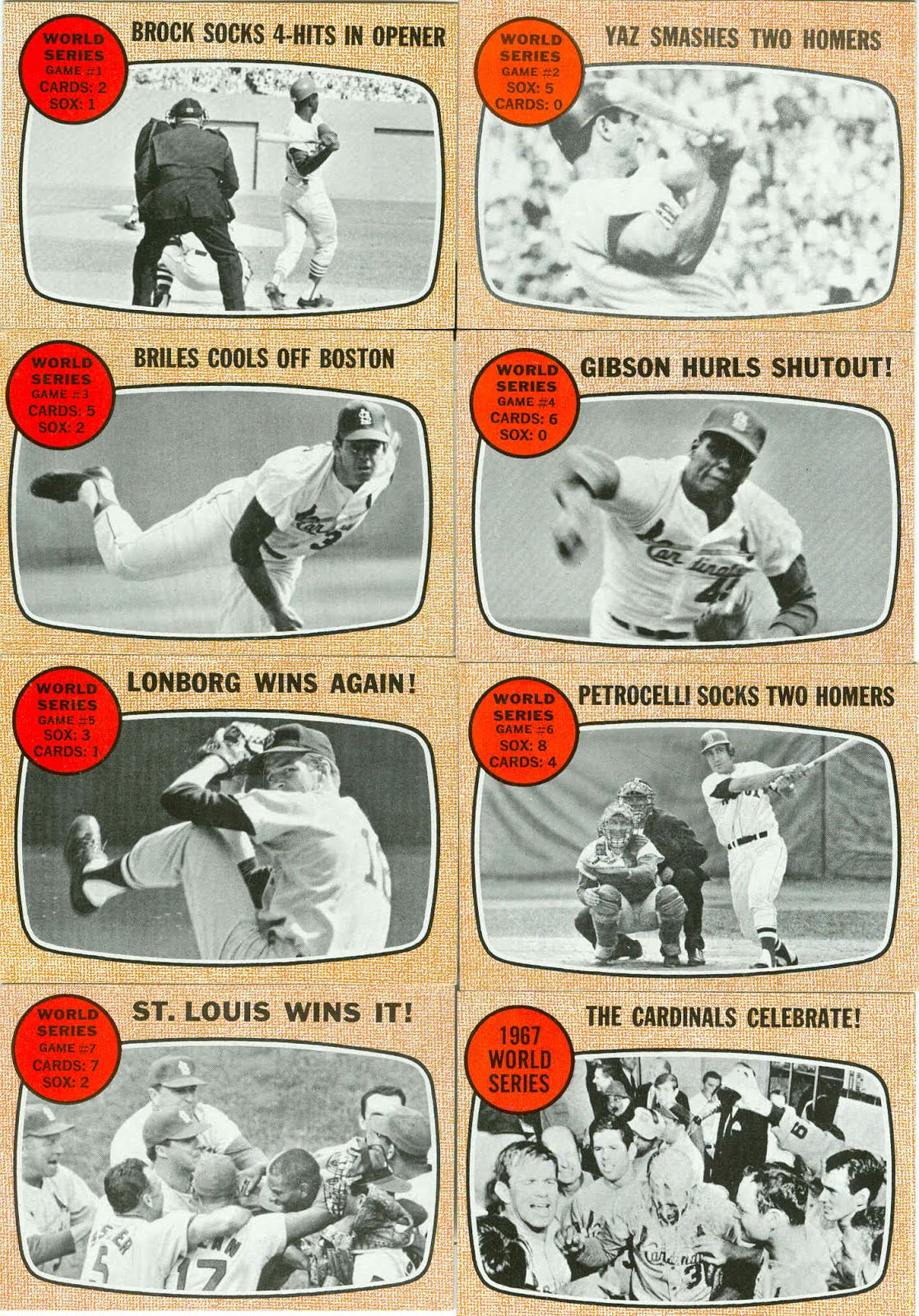
1967 World Series

I'd better get this posted, before the World Series ends.....


The 1967 Fall Classic featured the Cardinals and the Red Sox. The Cards were making their 2nd trip there in 4 years, while the Red Sox hadn't seen post-season action since 1946 (when coincidentally, their opponent was the Cardinals).

In 1967, Boston had just come off two 9th-place finishes, and entered the season not only with a new manager (Dick Williams), but it was Williams' 1st big-league managing assignment.

Leading the way for the rejuvenated Sox were triple-crown winner Carl Yastrzemski, pitcher Jim Lonborg, infielders George Scott and Rico Petrocelli, and outfielders Reggie Smith and (until his mid-August beaning) Tony Conigliaro.


The Cardinals were too much for the upstart Sox. This was a veteran club that had just won the Series in 1964, and had an all-star caliber player at just about every position.

In short...Gibson would just not lose. All St. Louis had to do was find one more win from among the rest of their rotation, which they did in game #3.

Monday, 22 October 2012

Phillies Rookies: Larry Colton / Dick Thoenen

This is the only Phillies Rookies card in the 1968 set (#348). (There was only one Phillies Rookies card in the '66, '67, and '68 sets. That number ballooned to 3 in the '69 set. Backlog of prospects? Nah.)

Each of these players had a major-league career lasting exactly one game. (Larry Colton pitched 2 innings on 5/6/1968, while Dick Thoenen pitched 1 inning on 9/16/1967.) This is the rookie card for both players, and the only card for Thoenen. Surprisingly, Colton re-appears on a 1969 Phillies Rookies card.


Larry Colton was signed by the Phillies in 1964, and was a starting pitcher in their farm system for 5 seasons (1965-69), starting at least 25 games each season except for 1968. That season, he spent part of the time riding the bench in Philadelphia, along with some time on the DL.

At the time, it was reported that he "hurt his shoulder reaching for the telephone on his bedside table". Years later, it was revealed that he was injured in a bar fight, and it cost him his shot in the majors.

After the '69 season, he was sent to the Cubs to complete the Johnny Callison for Dick Selma and Oscar Gamble trade. Colton pitched the 1970 season for the Cubs AAA team, then was out of baseball until pitching the 1975 season for an unaffiliated class A team.

At one time, Colton was married to the daughter of movie star Hedley Hedy Lamarr.


Dick Thoenen was signed by the Phillies in 1963, and pitched for 7 seasons in their farm system. Although a starting pitcher for his first 3 seasons, he was converted to a reliever at the start of the 1966 season and worked out of the bullpen in double-A (1966), and triple-A (1966-69).

His cup of coffee was pitching the 4th inning in relief of starter Rick Wise. After giving up hits to the Dodgers' Bob Bailey and Luis Alcaraz, he retired Don Sutton, Nate Oliver, and Wes Parker in order.

I found this write-up about Dick Thoenen recently at the 11th & Washington blog. At the end of the blog post, there's a newspaper clipping listing the Phillies' September 1967 call-ups. Larry Bowa was among them, although he wouldn't get into a major-league game until April 1970.