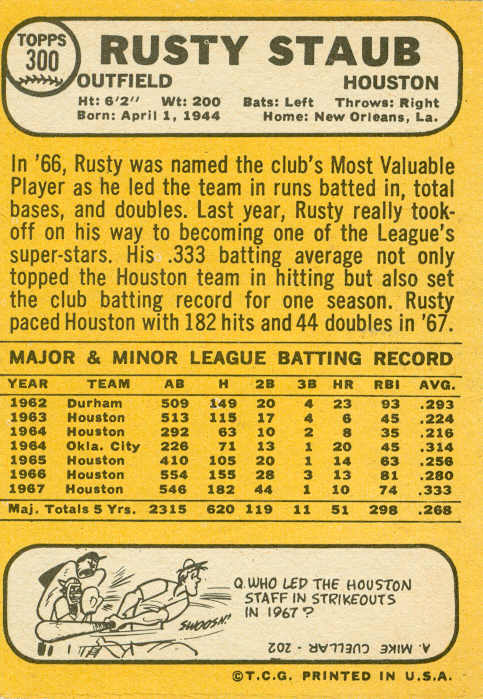
Continuing with the "hero numbers", today we have #300....Rusty Staub?!?
If I was compiling a list of "hero status" players from the late 1960s (and here's 58 names to get you started), I'm not sure Rusty Staub would be in my top 50, let alone the top 5. Yes, he was a good player, and one of the best 2 or 3 on the Astros at that time, but in the top 5 (for #100, 200, 300, 400 ,500)?
Here we see Rusty in Topps' patented 1968-69 Astros' regalia. (They forgot to airbrush-out the reflection of the Astros' logo on the helmet bill!) Staub is entering his final year in Houston, as he would become the Montreal Expos' "Le Grand Orange" in 1969.
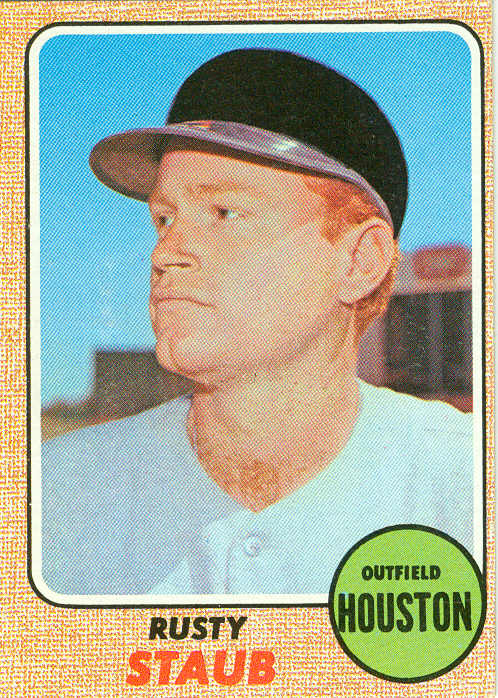
Staub was signed by the Houston Colt .45s in 1961 (before they even fielded a major-league team). He spent the 1962 season as a 1st baseman in class-B. Rusty made his big-league debut in April 1963 at age 19, starting 2/3 of his games at 1B and 1/3 in right field.
He was the starting 1st baseman for the first half of 1964, but lost the job to Walt Bond in early July. Rusty was the team's regular right fielder from 1965-67, then moved in to 1st base for the 1968 season.
In January 1969, he was traded to the expansion Expos for outfielder Jesus Alou and 1st baseman Donn Clendenon. When Clendenon refused to report (having had enough of manager Harry Walker while both were with the Pirates), the Expos sent pitchers Jack Billingham and Skip Guinn. Staub was an immediate hit in Montreal (see comment #5 here). Dubbed "Le Grand Orange", he was one of the Expos' bright spots in their early years. In his 3 seasons with the Expos, he averaged 160 games played as the team's right fielder, and made the all-star team each year.
Staub played right field for the Mets from 1972-75, then 3 1/2 seasons with the Tigers (as the right fielder in 1976, then the DH for the other years).
In July '79, he returned to Montreal for the remainder of the season. After one season (1980) with the Rangers, Staub spent the rest of his career (1981-85) with the Mets, mostly as a pinch-hitter.
Showing posts with label ...That's just Topps being Topps. Show all posts
Thursday, 29 August 2013
Thursday, 7 March 2013
Dick Hughes (#253)
Today I’m featuring the last of the 1967 Topps All-Rookie selections. Normally, 10 players were selected (including 1 left and 1 right handed pitcher). In the 1968 set, Topps not only left the cool trophy off 3 of the cards, but they decided that Dick Hughes would share the right-handed pitcher slot with Tom Seaver. (Imagine!)
Hughes was signed by the Cardinals in 1958, but was a late-bloomer, pitching 9 seasons in the minors before reaching the majors in September 1966 at age 28.
He had a phenomenal rookie season for the World Champion Cardinals in 1967, compiling a 16-6 record in 37 games (including 27 starts), while leading the staff in wins and innings pitched. (Bob Gibson missed a month of the season with a broken leg.) Dick finished second in the NL Rookie of the Year voting to Seaver.
Hughes spent most of the 1968 season in the bullpen, starting just 5 of his 25 games, and finishing at 2-2 in only 63 innings of work. What a difference a year makes! In the 1967 World Series, Dick started 2 games. In ’68, he pitched 1/3 of an inning in relief against the Tigers.
I’m guessing he had arm troubles, because he spent the 1969 season playing in the single-A Florida State League, then was out of baseball at the ripe old age of 31.
Saturday, 23 February 2013
Rich Nye (#339)
For some unknown reason, three of the players on the 1967 Topps all-rookie team do not have trophies on their card. I have previously posted the card for outfielder Rick Monday, leaving only pitchers Rich Nye and Dick Hughes to complete the subset.
Rich Nye was the lefthanded pitcher chosen for the 1967 Topps all-rookie team. Nye pitched from 1966-70, although his primary years were 1967-69 for the Cubs.
Rich was drafted by the Astros in 1965, but did not sign. He was signed by the Cubs in 1966, while pitching for UC Berkeley. Nye pitched for the Cubs' rookie and class-A teams that summer, then joined the big club in September.
After 2 relief appearances in 1967, Nye joined the starting rotation on April 30th, after other starters went by the wayside. He finished his rookie season with 13 wins and 119 strikeouts in 205 innings. All three of those numbers placed him 2nd on the staff, behind sophomore Fergie Jenkins. Topps apparently took notice (despite the missing trophy).
Nye slipped to 7-12 in 1968, and dropped to #5 in the rotation, behind Jenkins, Bill Hands, Ken Holtzman, and Joe Niekro. 1969 was worse yet, as he was relegated to the bullpen, making only 5 starts among his 34 appearances.
After the season, he was traded to the Cardinals for outfielder Boots Day. (Philly trivia: As a Montreal Expo in 1971, Boots was the first batter in Veterans Stadium history.) After 6 relief appearances (totaling 8 innings), Rich was sold to the Expos on May 15th, where he made 6 starts and 2 relief appearances. He was also used as a pinch-runner twice, and spent time with the Expos' AAA team in Winnipeg.
He played for three AAA teams (Expos, Indians, Pirates) in 1971, before his career was ended by a torn rotator cuff.
After his playing career, Nye began working as a civil engineer, before becoming a veterinarian.
A Rich Nye story here
Saturday, 18 August 2012
Final Card (the bonus tracks): Pete Mikkelsen
So, I was browsing through my 1968 binder, pulling all the final cards I previously posted, for a "Final Cards Recap" post (like I did with the 1967 set). After 2 or 3 pages, I was thinking "hey, what about this guy...and that guy... and that guy?"
I ended up with a list of 65 other players whose final card may have also been in the '68 set. After checking the Zistle database, I whittled the list down to 8 players (of which 3 are Cubs) that I missed the first time around. So here they are, the "bonus tracks".
Pete Mikkelsen's final card (#516) was in the 1968 set, despite the fact that he pitched over 150 games from 1969-72 as a member of the Dodgers' bullpen. Thanks, Topps!
Pete was signed by the Yankees in 1958, and played in the minors for 6 seasons, primarily as a reliever, but making many starts during the 1959-61 seasons. In his 9-year major-league career, Mikkelsen played 364 games, starting only 3 (in 1965).
His debut came in April 1964, and he appeared in 50 games, saving 12 as the Yankees' closer in his rookie season. After another season in the Bronx, Pete was traded to the Pirates for pitcher Bob Friend, who had been a key member of Pittsburgh's starting rotation for the past 15 seasons. Mikkelsen lasted just 1 1/2 seasons with the Bucs, and was claimed off waivers by the Cubs on August 4th, 1967.
The following April, he was traded to the Cardinals for pitcher Jack Lamabe. Ok! Moving up from the Cubs to the World Champion Cardinals! Not so fast... Pete pitched 5 games for St. Louis in June, but spent the rest of the season in triple-A.
After the season, he was traded to the Dodgers for a minor-league pitcher. Pete spent his final 4 seasons working out of the Dodgers pen, and it was a productive 4 years. The righthanded Mikkelsen was the team's #2 reliever during his 4-year stay, just behind ace southpaw Jim Brewer.
Why did Topps leave him behind? 1969 is understandable (after spending most of '68 in the minors), but what about the other years? The GarveyCeyRussellLopes blog has done what Topps was unwilling to do.
Sunday, 22 January 2012
Final Card: Dick Kenworthy
This is the only Topps card for Dick Kenworthy. The back says that he was sent to the Mets in the off-season as the player to be named later in the Ken Boyer trade. Interesting. Baseball-Reference.com makes no mention of Kenworthy ever being sent to the Mets. In fact, it says the White Sox sent J. C. Martin to the Mets on 11/27/67 to complete the trade. Since this is card #63, it must have been printed sometime in late 1967, so maybe Topps was acting on some preliminary scuttlebutt regarding Kenworthy.


Kenworthy was signed by the White Sox in 1961, and played in their minor-league system for 10 seasons, before moving over to the Reds' farm system for 1971 and 1972. He was a 2nd baseman for his first two seasons before switching to 3rd base for the balance of his career.
Dick's major-league experience consisted of a few cups of coffee from 1962 to 1966. Then in 1967 and 1968, he played over 50 games each season with the White Sox, about half of them as the starting 3rd baseman.
Since he played for the White Sox in both '67 and '68, it looks like Baseball-Reference.com is right and Topps was wrong. Maybe a White Sox fan can clarify this.
Sunday, 20 February 2011
Who didn't get a card, but shoulda...
Today, I'm continuing to pick at the shortcomings my analysis of the 1968 set.
As I posted earlier with the 1966 and 1967 sets, here is a list of some of the players who didn't appear on a regular or rookie card in this set, along with the number of games played in 1968:

Most of these are rookies who made their debut in 1968. Reggie Jackson is a different case. He made his debut with the Athletics in June 1967, but in 118 at-bats in 35 games, he only hit 1 home run. Maybe this caused Topps to write him off as a non-factor. Fortunately for us, our fellow blogger Steve at White Sox Cards has filled the gap.
Bobby Bonds wasn't called up until late June, but he had been tearing up the minor leagues for over a year. Other rookies who grabbed a starting job at the start of the season included Del Unser and Bobby Cox (who both made the Topps 1968 all-rookie team).
Non-rookies without a card were Indians' 1st baseman Tony Horton (who never had a card in his 6-year career), Roberto Pena (a journeyman shortstop who joined the Phillies in late April and took over the starting job in May for the injured Bobby Wine), and Red Sox pitcher Sparky Lyle.
I can't imagine how Topps could have overlooked Reggie Jackson and Bobby Bonds for their teams' rookie cards, but almost all of these players could have been added to the 7th series, which was months away. (Did we really need all those extra Mets cards?)
5-15-2011 edit:
Yesterday, I learned that relief pitcher Dick Radatz didn't have a card in the 1968 set. Radatz (nicknamed "The Monster") broke in with the Red Sox in 1962 and finished 3rd in Rookie of the Year voting. He led the AL in (what would have been) saves in 1962 and 1964. In June 1966 he was traded to the Indians, and in April 1967 he moved on to the Cubs.
From 1962 to 1967, Dick appeared in 62, 66, 79, 63, 55, and 23 games. His last major-league appearance in 1967 was on July 7th. No doubt that was the reason he was left out of the 1968 set. Still, the Braves' Tommie Aaron was afforded a card in 1968 after not having played since the 1965 season, so why didn't Radatz get similar treatment? Dick spent the entire 1968 season in the minors, before resurfacing for 1 final season in 1969 with the Tigers and Expos. His final card was in the 1969 set.
12-27-2011 edit:
In addition to Dick Radatz, these players also had cards in 1967 and 1969, but not in 1968:
Johnny Podres - P (was retired during 1968)
Jesse Gonder - C (1967 was last year in majors)
Bob Chance - 1B
Dave Nicholson - OF
Gary Geiger - OF
Tommie Reynolds - OF
Galen Cisco - P
Fred Newman - P
Tom Egan - C
Chuck Harrison - 1B
Jim Beauchamp - OF
John Kennedy - 3B
As I posted earlier with the 1966 and 1967 sets, here is a list of some of the players who didn't appear on a regular or rookie card in this set, along with the number of games played in 1968:
Most of these are rookies who made their debut in 1968. Reggie Jackson is a different case. He made his debut with the Athletics in June 1967, but in 118 at-bats in 35 games, he only hit 1 home run. Maybe this caused Topps to write him off as a non-factor. Fortunately for us, our fellow blogger Steve at White Sox Cards has filled the gap.
Bobby Bonds wasn't called up until late June, but he had been tearing up the minor leagues for over a year. Other rookies who grabbed a starting job at the start of the season included Del Unser and Bobby Cox (who both made the Topps 1968 all-rookie team).
Non-rookies without a card were Indians' 1st baseman Tony Horton (who never had a card in his 6-year career), Roberto Pena (a journeyman shortstop who joined the Phillies in late April and took over the starting job in May for the injured Bobby Wine), and Red Sox pitcher Sparky Lyle.
I can't imagine how Topps could have overlooked Reggie Jackson and Bobby Bonds for their teams' rookie cards, but almost all of these players could have been added to the 7th series, which was months away. (Did we really need all those extra Mets cards?)
5-15-2011 edit:
Yesterday, I learned that relief pitcher Dick Radatz didn't have a card in the 1968 set. Radatz (nicknamed "The Monster") broke in with the Red Sox in 1962 and finished 3rd in Rookie of the Year voting. He led the AL in (what would have been) saves in 1962 and 1964. In June 1966 he was traded to the Indians, and in April 1967 he moved on to the Cubs.
From 1962 to 1967, Dick appeared in 62, 66, 79, 63, 55, and 23 games. His last major-league appearance in 1967 was on July 7th. No doubt that was the reason he was left out of the 1968 set. Still, the Braves' Tommie Aaron was afforded a card in 1968 after not having played since the 1965 season, so why didn't Radatz get similar treatment? Dick spent the entire 1968 season in the minors, before resurfacing for 1 final season in 1969 with the Tigers and Expos. His final card was in the 1969 set.
12-27-2011 edit:
In addition to Dick Radatz, these players also had cards in 1967 and 1969, but not in 1968:
Johnny Podres - P (was retired during 1968)
Jesse Gonder - C (1967 was last year in majors)
Bob Chance - 1B
Dave Nicholson - OF
Gary Geiger - OF
Tommie Reynolds - OF
Galen Cisco - P
Fred Newman - P
Tom Egan - C
Chuck Harrison - 1B
Jim Beauchamp - OF
John Kennedy - 3B
Thursday, 17 February 2011
Distribution of teams within the 1968 set

Yesterday, I revisited my earlier post about the lack of a Giants Rookies card.
There were 25 cards for the Giants in 1968. However, in the 598 card set, the last Giant appears on card #545. This means that in the last 53 cards, there were no Giants. Was a planned Giants Rookies card pulled and replaced with someone else? Although the set starts off with each team being represented every 20 cards or so, in those final 53 cards, we have:
5 Mets (!?!)
4 Astros, Red Sox, Senators, and Yankees
3 Angels, Athletics, Indians, and Pirates
2 Braves, Cardinals, Cubs, Dodgers, Orioles, Reds, Twins, White Sox
1 Tigers and Phillies
The Phillies were really cut short, having only ONE card among the last EIGHTY-SIX cards!
A further analysis of the entire set shows that some teams had as many as 5 more cards than other teams:
30 Orioles, Reds, Red Sox
29 Astros, Cubs, Mets, Senators
28 Athletics
27 Cardinals, Dodgers, Pirates, Twins, White Sox
26 Angels, Yankees
25 Braves, Giants, Phillies, Indians, Tigers
20 All stars
12 Leaders
8 World Series
7 Checklists
5 Other
So, my long-time suspicion that the Phillies were short-changed in the 1968 set turns out to be correct. (Trades were not the reason, as the only significant off-season Phillies' trades were Jim Bunning for Woodie Fryman, and Dick Ellsworth and Gene Oliver for Mike Ryan, which gives an imbalance of 1 card.)
Topps' late-series push of excessive Mets, Astros, Red Sox, and Senators cards sent the totals for those teams soaring above the team average.
Tuesday, 5 October 2010
Don Lock (#59)
First, let me point out that the late-1960s cards of Don Lock are the most complete example of Topps' photographical laziness that I have found. Lock was traded to the Phillies in November 1966. His 1967 card shows him in a hatless photo. Fine, no problem there, because he was just traded. But, here it is ONE YEAR LATER, and Topps puts out another hatless card of Lock (with a different photo than 1967). To top it all off, Don's 1969 card (still with the Phillies, mind you) has ANOTHER hatless photo! More than 2 seasons after his trade from the Senators, and while on the Phillies roster for all that time, Topps couldn't squeeze out a new photo of Don Lock.
Don Lock was signed by the Yankees (I didn't know that until today) in 1958, and spent over 4 seasons on the Yankees' farm, until he was traded to the Senators on July 11, 1962 for 1st baseman Dale Long. Six days later, he made his major-league debut with the Senators. He started 63 of the final 76 games that season, all but one in left field.
.jpg)
.jpg)
In 1963, Don began the season as the center fielder, and except for a stretch of 19 consecutive games in late April and early May, he was the undisputed #1 in center, with 129 starts there. He also started 9 games in right field. Lock bashed 27 homers in his first full season.
1964 was more of the same, with Lock making 120 starts in center, compared to Ken Hunt's 30 starts. Don also started 25 games in right field, spelling regular Jim King. He also hit 20 home runs.
1965? The center field scoreboard says Don Lock 116 games, Woodie Held 34 games. Replaced by Woodie Held? That's what happens when your average drops to .215 and you only hit 16 home runs.
1966? Lock 101, Fred Valentine 55. Don's playing time is similar to 1965, but for the 2nd straight year, he hits a mere 16 home runs and collects less than 50 RBI.
Lock seems to be slipping in his last 2 seasons with the Senators. This affirms what I have often thought was a bad trade made by the Phillies in the mid-1960s (and always overlooked, in the shadow of the Fergie Jenkins trade). The Phillies traded pitcher Darold Knowles, who led the team in saves during his rookie season in 1966, for a starting outfielder who, under closer examination, was already on the decline. I can remember back in the 1960s, one of the "great reasons" to get Lock was that he "hit 99 home runs with the Senators" (something that is repeated on the back of this card).
Knowles went on to accumulate 143 saves in a 16-year career, which ended in 1980. Lock was heavily platooned during his 2 full seasons with the Phillies, and was sent packing to the Red Sox in early May 1969, for a guy whose entire major-league career consisted of one at-bat in 1965. Lock remained with the Red Sox through the end of the 1969 season, before retiring.
"Highly sought-after slugger"? Bah!
Wednesday, 26 May 2010
Multi-player Cards
Continuing with the theme from yesterday's post on my 1966 blog, here are the only 3 multi-player cards in the 1968 set.
.jpg)
#530 Bird Belters - These 2 players appeared (along with manager Hank Bauer) on card #1 in the 1967 set, as members of the 1966 world champion Orioles. It seems odd that Topps printed another Orioles' multi-player card in 1968, after issuing two in 1967. (A card for the 1967 champion Cardinals would have made more sense.)
.jpg)
#480 Manager's Dream - Here's a departure from the normal multi-player cards: players from different teams posing together. This would be Cardenas' last season in Cincinnati before shipping out to the Twins.
.jpg)
#490 Super Stars - One of the last cards featuring Mickey Mantle (no doubt taken at the 1967 All-Star Game).
.jpg)
#530 Bird Belters - These 2 players appeared (along with manager Hank Bauer) on card #1 in the 1967 set, as members of the 1966 world champion Orioles. It seems odd that Topps printed another Orioles' multi-player card in 1968, after issuing two in 1967. (A card for the 1967 champion Cardinals would have made more sense.).jpg)
#480 Manager's Dream - Here's a departure from the normal multi-player cards: players from different teams posing together. This would be Cardenas' last season in Cincinnati before shipping out to the Twins..jpg)
#490 Super Stars - One of the last cards featuring Mickey Mantle (no doubt taken at the 1967 All-Star Game).
Tuesday, 20 April 2010
Back on Topps' Radar: Roy White
Here is the first "full" card for Roy White (#546). White appeared on a Yankees Rookies card in 1966, but did not have a card in 1967, despite having 356 plate appearances for the Yankees in 1966. C'mon Topps, why was White left out of the 1967 set, while this guy (who had exactly ZERO major-league games played prior to this card being issued, and whose subsequent major-league career consisted of 2 games) gets his own card?
White was signed by the Yankees in 1961, and played 4 seasons in the minor leagues as a 2nd baseman, before making his Yankees debut (as an outfielder) in September 1965. He spent the entire 1966 season with the Yankees, and started 66 games in left field that season (when Tom Tresh, the Yankees' regular left fielder, would move in to play 3rd base).
.jpg)
.jpg)
In 1967, Roy didn't start a game for the Yankees until July 19th, when he started 15 of the next 18 games at 3rd base. After spending all of 1966 with the Yankees, White played 84 games with triple-A Spokane (a Dodgers' farm team) playing exclusively at 3rd base. My theory is that the Yankees (who had traded long-time 3rd baseman Clete Boyer to the Braves in the off-season) were trying to convert White to a 3rd baseman. That experiment seems to have lasted 3 weeks at the big-league level, because by August, he was in right field, and would never play 3rd base again during his career.
White was the Yankees' regular left fielder from 1968 to 1973, and was all-star in 1969 and 1970. In 1970, he started 161 games in left, and in 1973 he started 162 games in left.
In 1974, he split his time between LF and DH, before returning to full-time left field duty from 1975-77. Beginning in 1978, Lou Piniella took over in left field, relegating White to backup status. He would play for the Yankees until retiring after the 1979 season.
Roy White was the Yankees' one link between the Mickey Mantle and Reggie Jackson eras.
Subscribe to:
Posts (Atom)
.jpg)
.jpg)
.jpg)
.jpg)
.jpg)
.jpg)